Video Production Contract Revisions: What Counts as a Round?
· Ty Turner
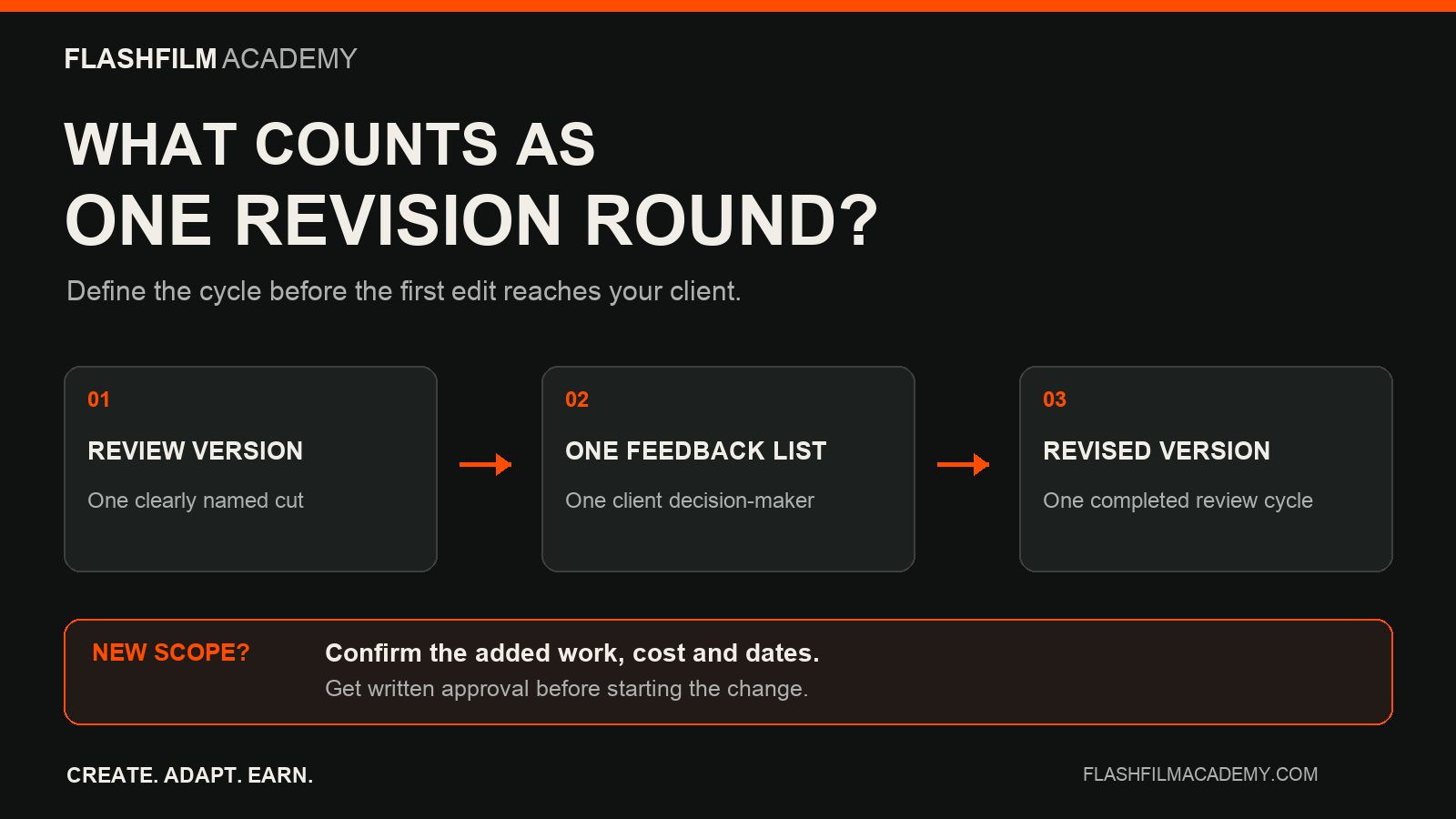
A useful way to define one revision round in a video production contract is one consolidated set of feedback on a specific version of the video, followed by one revised delivery. Agree on who submits that feedback, when it is due, which changes fit the original scope and how additional work gets approved. The number of rounds matters less when nobody understands what a round includes.
This guide is for videographers producing client interviews, brand videos, testimonials and social content. It offers a practical review process to discuss with your client and legal adviser; it is not legal advice or a clause guaranteed to work in every jurisdiction.
Start with the deliverables the client actually bought
Before you decide how many revisions to include, list the finished work. “One brand video” leaves too much open. A more useful production brief might specify one 90-second horizontal film, three 15-second vertical cutdowns, English captions and one thumbnail per version.
Then decide whether a round covers all those deliverables together or whether each deliverable has its own review process. Neither arrangement is automatically right. The important part is that both sides understand the same arrangement before work starts.
Use the video production brief template to confirm the audience, message, deliverables and decision-maker. The brief describes the creative job; your agreement should address the responsibilities, commercial terms and process attached to it.
Define a revision round in ordinary language
A workable review process answers five questions:
1. Which version is being reviewed? Name it clearly, such as Brand Film V1, rather than leaving several similarly named exports in circulation.
2. Who collects the feedback? Ask the client to nominate one person who can reconcile comments from the relevant stakeholders.
3. How is it submitted? Choose a single review tool or document, with timecodes when comments concern a particular shot or line.
4. When does the list become final? Give the client an agreed deadline and a way to confirm that everyone has responded.
5. What happens next? Explain when you will acknowledge the list, flag scope questions and provide the revised version.
The client should understand that a review round is a planned cycle. It should not become an indefinite stream of unrelated requests spread across text messages, email and phone calls.
Separate revisions, production corrections and new scope
These categories are a useful discussion framework, not universal legal definitions. Agree on how you will handle them in the project documents.
An in-scope revision changes an existing deliverable within the approved direction. For example, replacing one selected interview soundbite with another from the same approved material may fit the original scope.
A production correction addresses something that does not match the agreed specification: your export has the wrong dimensions, or you introduced a typo while adding a supplied title. Explain how you will correct your own errors instead of leaving the client to guess whether a mistake consumes their revision allowance.
New scope changes what is being made or adds work beyond the agreed job. Examples include a new shoot day, a second language, a new animation sequence or extra social edits that were never included.
A change that sounds small can still affect several deliverables. Replacing the music may require retiming the main film and each cutdown. Explain the work involved before calling a request “minor” or “major.”
Example: five stakeholders do not have to mean five revision rounds
Imagine a fictional local fitness company commissioning a customer testimonial film. The owner, marketing manager and three team members all want to review it.
You deliver V1 on Monday. The marketing manager gathers the team's comments into one timecoded list by the agreed deadline. Before editing, you confirm two conflicting notes: one reviewer wants a longer opening, while another wants to remove it. The authorized client contact chooses a direction. You then deliver V2.
That is one complete review cycle under the proposed workflow. The number of people who contributed does not determine the number of rounds.
Now suppose the owner asks for an additional testimonial from a different customer. That is a separate scope discussion. You can explain the added filming, editing and schedule implications, then ask for written approval of the additional work and fee before starting it.
Make the price and approval path visible before extra work starts
Choose a pricing method you can explain and administer. Options include a defined fee for an additional round, an hourly rate with an approved estimate, or a fixed quote for a specific added deliverable.
Do not assume that naming an extra-round fee resolves every change. Another review cycle on an existing film is different from creating a new film. State what your extra-round fee covers and what requires a separate quote.
A change request should identify the request, affected deliverables, proposed cost, revised dates and person authorized to approve it. Keep that approval in the agreed communication channel. Avoid making the change first and surprising the client with a new charge afterward.
Connect the feedback schedule to the delivery schedule
The delivery date depends on production work and client decisions. Agree on feedback windows early and describe how you will handle missed deadlines or extended pauses.
For example, if feedback arrives after the edit time reserved for that project, you may need to offer a new available slot. Explain this scheduling process before the project begins. Do not invent an automatic late fee or an “approval by silence” rule after the client has already missed a deadline.
Before the final export, obtain approval of the specific version and check the deliverables list. The Academy's client video review workflow can help you organize that review stage.
What to review in the Academy's video production agreement
The Video Production Agreement supplied in the Academy's contract pack includes fields for revision rounds, additional costs and the time allowed for revisions. It also addresses additional costs from changes to a completed project or work in progress. Those fields are prompts for decisions you still need to make; leaving them blank does not define your process.
Review the whole agreement, not just the revision section. Check that your deliverables, payment arrangements, project term and ownership terms fit the job. Remove or resolve incompatible options with appropriate legal help before using a template with a client.
Ownership deserves its own decision. The supplied agreement includes work-made-for-hire language; do not assume a revision allowance establishes copyright ownership. In the United States, the requirements for commissioned works made for hire are specific, including qualifying uses and a signed written agreement. The U.S. Copyright Office's explanation is a useful starting point for discussing the intended ownership arrangement with counsel.
Explore the Video Production Agreement or the paid Ultimate Contract Pack if you want editable documents to review and adapt. These are paid resources and are separate from the free prompt kits below.
A revision checklist before you send the agreement
- Name every deliverable and the approved creative direction.
- State how many rounds are included and which deliverables they cover.
- Identify the authorized client contact and the feedback channel.
- Define how comments become one consolidated list.
- Agree on feedback windows and the scheduling process for delays.
- Explain corrections, in-scope revisions and changes requiring a new quote.
- Specify how extra costs and work receive approval.
- Confirm final sign-off and delivery requirements.
Frequently asked questions
How many revision rounds should a videographer include?
There is no single number that suits every project. Choose based on the deliverables, stakeholder group, creative uncertainty and time included in your price. Whatever number you choose, define the cycle and boundaries clearly. This article does not claim an industry-standard allowance.
Should every client comment count as a round?
Under the workflow described here, no. A round is the agreed cycle of consolidated feedback and revised delivery. Clarify that arrangement before the client reviews V1, including how later additions to an already confirmed feedback list are handled.
Does a new aspect ratio count as a revision?
Check the agreed deliverables. If the vertical version was included, producing it is part of the job. If only a horizontal film was commissioned, discuss the added reframing, graphics, captions and export work before treating the vertical version as included.
Find the work your pricing is missing
If revisions regularly take more time than you expected, start by making that work visible. Use the Hidden Work Tracker, one of FlashFilm Academy's ten free prompt kits, to examine the tasks around your creative work and check them against your own project records.
Get the free prompt kits. Enter your email for a free community access invitation and Academy emails, then create or sign in to your Academy account to use the kits. Unsubscribe from emails anytime. The free kits do not require a paid course membership. Already a member? Open the Free Prompt Kit space with your existing account and choose Hidden Work Tracker.
For structured training and community support as you improve your offers, production process and client communication, explore the paid Academy membership. The membership is separate from these free kits. Explore FlashFilm Academy membership.
CREATE. ADAPT. EARN.
YOUR NEXT STEP · START FREE
Take one useful step toward a stronger creative business.
Get ten free prompt kits for photographers and videographers. Research buyers, clarify your offer, track hidden work or prepare for shoot day—then check the results against real evidence.
Get the free prompt kitsEnter your email for a free community access invitation and Academy emails. Unsubscribe anytime. Already a member? Open this resource with your existing account.
Looking for editable agreements? Explore the paid Ultimate Contract Pack. Templates are not a substitute for independent legal advice.
Build on your first step with structured training and community. Explore Academy membership.
Join the conversation.
Read along, ask a question, or share your experience. Comments are open to active FlashFilm Academy members.
Loading comments…