Photography Discovery Call Recap: Before You Quote
· FlashFilm Academy
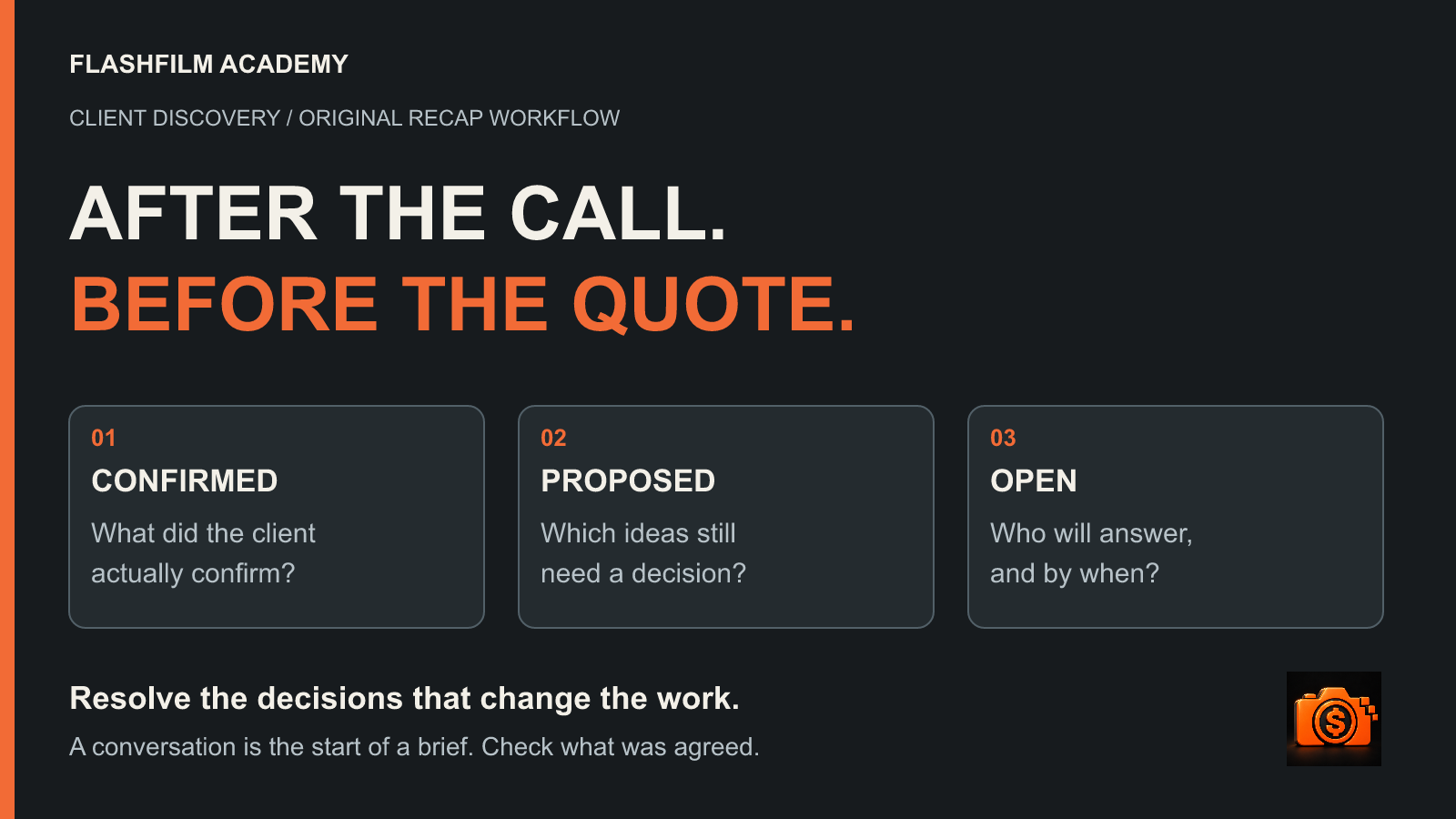
After a photography discovery call, send a short recap that separates what the client confirmed from your proposed approach and the questions still unanswered. Record the business need, intended image use, deliverable assumptions, decision-maker and next action. Resolve anything that materially changes the work before presenting it as a firm quote.
This guide is for photographers and videographers working with business clients. It focuses on the step between a promising conversation and a priced proposal: turning your notes into a clear decision record the client can correct. You can use the same method after a video-production consultation.
Separate three kinds of notes while the conversation is fresh
A discovery call often mixes facts, suggestions and possibilities. If your recap presents all three as agreed scope, you can accidentally promise a location, image count or delivery date that nobody confirmed.
Review each important note and give it a plain-language status:
- Confirmed: the client explicitly supplied or approved this detail. Keep enough context to identify what was said and by whom.
- Proposed: this is your suggested way to address the need. It still needs a decision before you treat it as the selected scope.
- Open: an answer is missing or conflicting. Name the person who will resolve it and when the answer is needed.
Use written labels rather than color alone. “Proposed: one workshop photography session” is clearer than placing a tentative idea beside a green checkmark. Keep the original notes separately so you can trace how the working brief developed.
Confirm the problem before repeating the requested deliverable
A client may ask for twelve photographs while describing a problem those photographs have not yet been designed to solve. Write down the situation, audience and intended next action before recommending the coverage.
For example, a furniture maker might need customers to understand the finishes available in a new collection. That is more specific than “needs better social content.” Ask where the images will appear and what buyers currently struggle to understand. If the client reports repeated questions, label that as the client's observation unless you have reviewed the underlying evidence.
Separate the intended outcome from a guarantee. You can agree to produce clear finish comparisons and a useful product image set. You cannot treat an untested image campaign as proof of future orders. If the client wants to evaluate inquiries or sales, identify who will provide the baseline and how the measurement will be interpreted.
Make the image count and intended use unambiguous
Turn a broad number into a concrete coverage question. Does “twelve images” mean twelve finished files, twelve product views or twelve separate products? Are alternate crops included in that count? Is retouching expected on every selected photograph, and who chooses the final images?
Ask which organization will use the work, in which placements and for what purpose. Website product pages, organic social posts, advertising and a retailer's catalog can create different requirements to discuss. Record the requested uses without assuming that an informal recap establishes the final license.
ASMP's Working with an Assignment Photographer guide distinguishes the assignment description, licensing and pricing when preparing an estimate. Use that planning distinction to keep the client's requested coverage and intended use visible. It is an industry guide, not a current rate card or legal advice about your engagement.
Once the scope is clearer, our photography package-comparison guide helps present meaningful options. Keep this recap focused on confirming the information those options will depend on.
Give each open question an owner and a decision date
“Client to confirm” is easy to overlook when several people are involved. Identify who can answer each question and which decision depends on it. A product manager may confirm the finishes; an operations contact may confirm workshop access; the marketing lead may approve intended placements.
Separate people who provide information from people who approve the project. Ask who can approve scope and budget, who checks technical accuracy and who will consolidate feedback. Adobe's client video collaboration guidance recommends defining team roles and responsibilities early and keeping communication organized. The same practical habit helps a photography project move from discovery to an agreed brief.
Work backward from the client's intended launch. Distinguish launch, final delivery, review and shoot dates. If access or product readiness is unresolved, explain why a proposed shoot date remains provisional. Record your actual booking process rather than implying that a conversation automatically reserves the calendar.
Example: twelve images, six pieces and two finishes
Imagine a fictional furniture maker requesting twelve photographs of six pieces, each available in two finishes. The client wants website and organic social use, but has not specified which views or crops are required. This is an original editorial example, not an Academy client's project or the paid worksheet's completed example.
Twelve could mean one photograph of each product-and-finish combination. It could also mean twelve selected photographs across the collection, with some pieces shown in only one finish. Those choices affect preparation, styling, coverage and image selection. Do not silently choose the interpretation that makes the initial number easiest to price.
A useful recap would record the six-piece collection as confirmed, the proposed single workshop session as proposed, and the product/finish/view list as open. Ask the named client contact to identify the required combinations and confirm that the correct items will be ready before the shoot.
You might offer to prepare a priced scope after that list is approved. If the client needs an early planning estimate, state the assumptions and exclusions clearly, explain which figures are provisional and identify what could change them. Do not label a conditional estimate as a fully settled booking.
Send a recap that invites a specific correction
Use a short subject line with the client, project and date. Put the decision request near the beginning, then organize the details so the client can reply to the unresolved points. The following is an original example message, not a reproduction of the paid worksheet or a contract clause.
“Thanks for today's conversation. My understanding is that the collection photographs need to help website visitors compare the available finishes. Before I prepare the priced scope, please confirm the product-and-finish list and the required views for each item.
“I am proposing one workshop session, subject to checking access and product readiness. Website and organic social use were discussed; please flag any planned advertising or third-party use so we can address it in the proposal and agreement.
“Please send the coverage list by the decision date we discussed. I will then confirm the scope, available production dates and when you can expect the proposal.”
Replace the example details and timing with the real conversation. If you suggested an answer the client has not accepted, preserve its proposed status. Avoid an unqualified “everything is confirmed” closing when material questions remain open.
Carry the answers into the estimate and agreement
When the client responds, update the working record instead of leaving the answer in a separate message thread. Keep the version date and identify which questions are now resolved. If two stakeholders provide incompatible instructions, ask the authorized decision-maker to settle the conflict.
Use the confirmed information to estimate preparation, production, selection, finishing and delivery work. Our photography labor-estimating guide explains how to account for work around the shoot. Your selling price still needs to reflect the complete service and agreed rights, not just time with the camera.
The recap, proposal, agreement and production plan should describe a consistent project. Complete the actual acceptance and booking steps required by your process. A completed worksheet is a planning record; it is not evidence that payment, signatures, access permissions or every other booking requirement has been completed.
Use the Academy worksheet for your next discovery call
Join the paid FlashFilm Academy to access the Client Discovery Call Worksheet and Tools & Templates. The current resource provides an editable Word worksheet, a fillable PDF, a fictional completed example within the working documents, a walkthrough video and its transcript. Save a separate client copy and replace the example assumptions before using it.
We inspected the current downloadable resource pack and its full Word document. It organizes the conversation around the business situation and the information needed to qualify the work and agree on a next step. Use it to collect the answers during discovery, then apply the confirmation process in this article before quoting.
This is access through a monthly or annual Academy training membership, not a standalone worksheet purchase. Separately sold contract products have their own purchase terms. Existing members with access can open the Client Discovery Call Worksheet space.
Want a separate free starting point? Get the ten free Prompt Kits and choose Client Problem Finder, kit 02 to explore the buyer problem before the conversation. Check AI suggestions against the real client's answers; suggested problems are not verified evidence.
The free kits require an Academy account, Academy marketing email opt-in for new free-resource access and confirmation when prompted. No paid membership is required for the kits, and you can unsubscribe anytime. Access to your chosen AI tool and usage costs are separate. Bring an anonymized recap to the paid community when you want to discuss its clarity without exposing private client information.
Common questions
Should I quote immediately after every discovery call?
Quote when you have enough reliable information to define and estimate the work. If a missing answer could materially change coverage, permissions, finishing or timing, resolve it or make the estimate's conditional assumptions clear. Do not fill the gap with an unstated promise.
How long should the recap be?
Keep it as short as the decisions allow. The client should be able to identify the confirmed need, your proposed approach, the unanswered questions and the next action without rereading the entire conversation. Link supporting material when it is needed and permitted.
Can AI turn my call notes into the recap?
It can help organize material you are authorized to share with the service, but review every name, number, status and commitment yourself. Do not upload confidential material without appropriate permission. Remove invented details and check that proposed ideas have not been rewritten as client approvals.
YOUR NEXT STEP · START FREE
Take one useful step toward a stronger creative business.
Get ten free prompt kits for photographers and videographers. Research buyers, clarify your offer, track hidden work or prepare for shoot day—then check the results against real evidence.
Get the free prompt kitsEnter your email for a free community access invitation and Academy emails. Unsubscribe anytime. Already a member? Open this resource with your existing account.
Build on your first step with structured training and community. Explore Academy membership.
Join the conversation.
Read along, ask a question, or share your experience. Comments are open to active FlashFilm Academy members.
Loading comments…