Wedding Photography Coverage Hours and Overtime: What to Agree Before Booking
· FlashFilm Academy
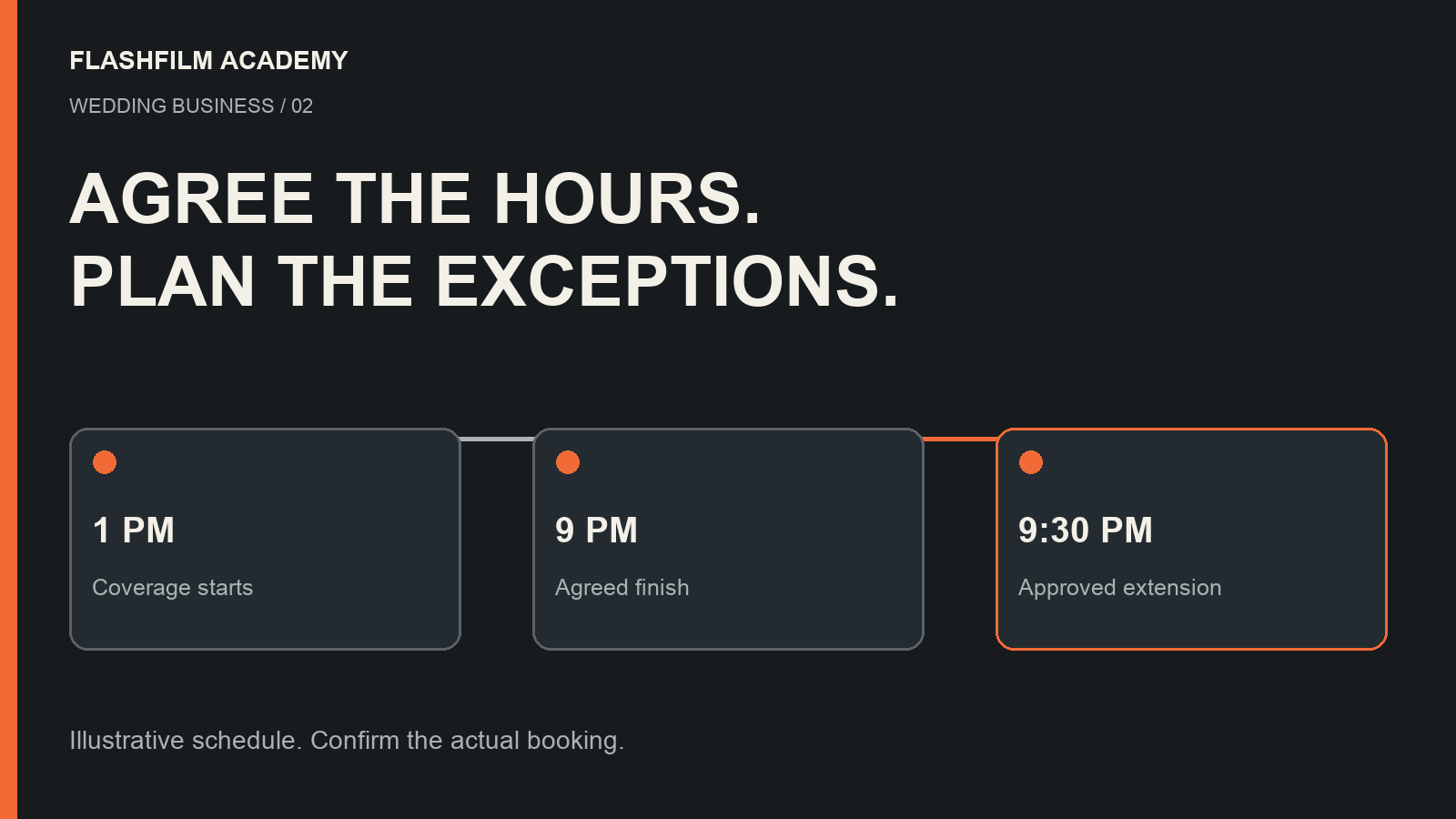
A wedding photography contract should state the start and end of coverage, the locations, the photographers assigned, how travel and breaks affect the schedule, and the process for authorizing extra time. In this guide, “overtime” means extra client coverage beyond the booked window; employee overtime pay is a separate issue. Avoid relying on “all-day coverage” unless you have also explained exactly what that means for the booking.
The goal is practical: the couple should understand which moments fit their package, and the photographer should know when the job starts, when it finishes and who can approve a change. This is a planning guide for photographers; have local counsel review the terms you put into an agreement.
Build coverage around the moments that matter
Begin with priorities, not an arbitrary number of hours. Ask the couple to identify the moments they care about most: preparations, first look, ceremony, family groups, speeches, dancing or the exit. Put those moments on the actual event timeline.
Then add the work between them. Moving equipment, finding parking, reaching a hotel room and travelling between venues all take time. A timeline made only of ceremony and reception events can look comfortably short while leaving no time to move between locations.
If the chosen package cannot cover all priorities, present concrete choices: start later, finish earlier, simplify locations or purchase more coverage. Discussing these tradeoffs before booking is easier than explaining a surprise on the wedding day.
Put a clock time beside both ends of the booking
An eight-hour package needs a defined window. In a hypothetical booking from 1 p.m. to 9 p.m., a 9:30 p.m. exit falls outside that window. The couple can move the exit, shift the coverage window if feasible, or request an extension.
Record who receives schedule updates and when the final timeline should be confirmed. If the planner sends a revised run sheet, compare it against the agreement rather than assuming every change is included.
The FlashFilm Academy wedding photography agreement reviewed for this guide contains start and end times, ceremony and reception locations, schedule-confirmation language and a section addressing additional shooting time. The business still needs to supply the details that make those provisions workable for its package. The reviewed template does not supply your overtime rate, billing increment or a named approval contact: agree and document those details rather than assuming the template chooses them for you.
Explain travel, breaks and multiple photographers
Specify how time moving between locations is treated. If coverage is continuous, explain that a thirty-minute drive occurs within that window. If you offer split coverage, document the separate blocks and the availability commitments between them.
List each photographer's assignment. A lead photographer working eight hours and a second photographer working six hours is not the same as both photographers working eight hours. Explain which preparations or locations the second photographer is expected to cover.
Plan meal and rest arrangements around the event schedule, the crew's needs and applicable requirements. Coordinate with the planner so a key event is not deliberately scheduled during an agreed break. Do not treat the client’s coverage window as a payroll rule. The U.S. Department of Labor’s meal and rest-break guidance explains that federal and state requirements can differ. Check the rules that apply to your crew’s working arrangement and location; the client agreement does not replace those obligations.
Make overtime an approval process
“Extra hours cost more” leaves several questions unanswered. Decide the rate or method of calculation, the billing increment, whether availability is required, and who may authorize additional work.
Use a simple extension checklist:
- Confirm the new end time and the moment the extra time is intended to cover.
- Identify which photographers are staying.
- Explain the charge and billing increment already agreed for extensions.
- Get approval from the authorized person using the agreement’s change procedure, including any required written signatures.
- Record the actual extension and send a clear follow-up summary.
Do not assume a venue employee, guest or relative can authorize a charge to the couple. Name the appropriate contact in advance. A planner can be that contact if the parties have agreed to it.
Walk through a delayed-reception example
Imagine coverage ends at 9 p.m., but the first dance moves from 8:30 p.m. to 9:15 p.m. At 8:30, the photographer informs the agreed contact rather than silently staying and invoicing afterward.
Suppose this hypothetical package offers extensions at $300 per hour, billed in thirty-minute increments, and the team is available. An approved extension to 9:30 would add $150. That is the client’s extension charge, not a calculation of employee overtime pay. Those numbers illustrate the calculation only; they are not industry rates or a recommendation for your business.
A plain-language planning note could say: “Coverage is currently booked until 9 p.m. The first dance is now expected at 9:15. If approved under our agreement, the available team can stay until 9:30 for an additional $150. Please confirm using our agreed change process.” This is an illustrative conversation, not a ready-to-use legal clause.
The approval should identify the revised end time and what the team expects to capture. It should not imply that every reception event is now included indefinitely. If the client declines, clarify the remaining priorities within the original window.
Handle lateness without making the conversation adversarial
Explain before the wedding how delays affect the remaining coverage. A delayed start does not automatically answer whether the finish time moves; the agreement and any approved change should settle that question.
Offer practical choices when circumstances change. If family portraits run late, the couple may prioritize a smaller group list, use a later portrait opportunity, or request more time. Keep the conversation focused on their priorities and the available options.
Avoid promises that every person or moment can be photographed regardless of access, cooperation or timing. Discuss venue rules and foreseeable constraints during planning, with a clear route for raising new issues.
Make the proposal, contract and timeline agree
Before sending the booking documents, compare these five items across all three:
- The same date, locations and coverage window.
- The same number of photographers and their individual hours.
- The same included events and deliverables.
- The same process and pricing basis for extra time.
- The same contact and method for confirming changes.
A helpful final check is to read the documents as a client who has never booked a professional photographer. If one page says “full day” and another gives an eight-hour window, replace the ambiguity with a consistent description.
Buy the wedding photography template
Buy the Wedding Photography Agreement for $39.99 to start from an editable document covering the engagement. The product is sold as a one-time digital purchase with Word, PDF and fillable PDF formats. Customize the schedule, responsibilities and extra-time details for your actual service, and obtain legal advice appropriate to your location.
For a business handling weddings alongside other photo and video jobs, buy the $99 Ultimate Contract Pack. Its broader library is an alternative to buying only the wedding agreement; check the current product page for the included agreements and bonuses.
To prepare the day's practical checklist, get the Free Prompt Kits and use Shoot-Day Readiness Checklist. Create or sign in to your Academy account first, opt into Academy marketing emails for new free-resource access, and confirm your subscription when prompted. No paid membership is required; AI-tool access and any usage costs are separate. Review generated suggestions with the couple and planner rather than treating an AI output as the final timeline. Paid Academy membership adds structured training and community support for developing the business behind your photography.
If you also sell wedding films, use our wedding video deliverables guide to keep the film package as specific as the photography schedule.
Common questions
Does an eight-hour package include travel between venues?
The package should say. Specify whether travel falls within continuous coverage or whether a different arrangement applies; do not leave the client to infer it.
Should the second photographer stay for the entire reception?
Base that decision on the promised coverage and staffing plan. Document their hours and the effect of any extension separately from the lead photographer's hours.
What if the couple wants the photographer to stay but the team is unavailable?
Discuss extension availability before booking and again when the timeline is finalized. Do not imply that extra coverage is guaranteed simply because a rate exists. Work through feasible alternatives while there is still time to plan.
Sources and scope
The contract references above come from FlashFilm Academy’s Wedding Photography Agreement, reviewed alongside its current product listing on October 28, 2026. The coverage checklist, example timeline and extension calculation are original planning examples, not claims about what every wedding package includes. This is general business education; contract requirements and employment rules vary by jurisdiction. Obtain qualified advice for your own terms and staffing.
YOUR NEXT STEP · START FREE
Take one useful step toward a stronger creative business.
Get ten free prompt kits for photographers and videographers. Research buyers, clarify your offer, track hidden work or prepare for shoot day—then check the results against real evidence.
Get the free prompt kitsEnter your email for a free community access invitation and Academy emails. Unsubscribe anytime. Already a member? Open this resource with your existing account.
Build on your first step with structured training and community. Explore Academy membership.
Join the conversation.
Read along, ask a question, or share your experience. Comments are open to active FlashFilm Academy members.
Loading comments…