Creator Contract Templates for Photography and Video Projects
· Ty Turner
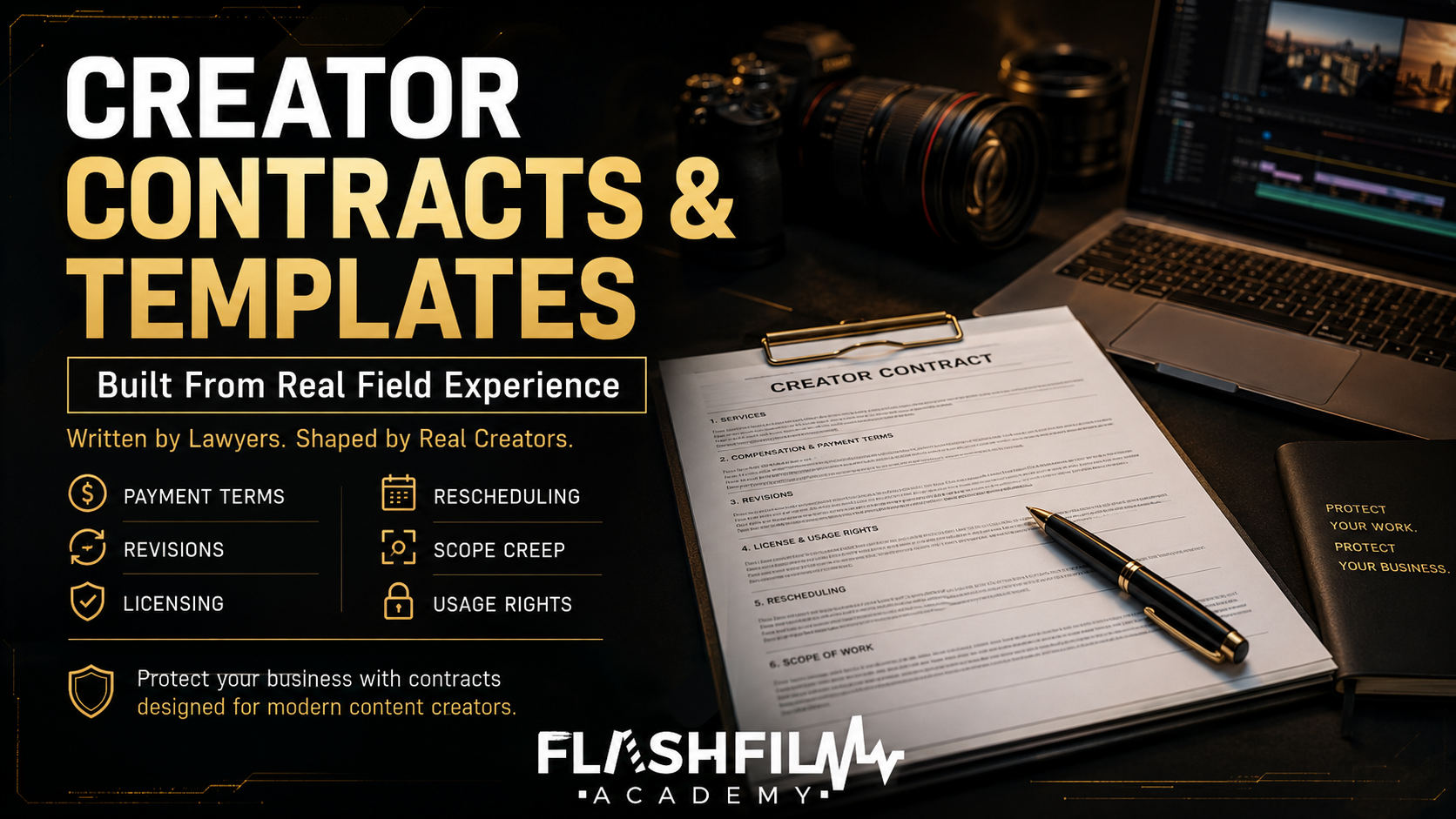
If you are a photographer, videographer, filmmaker, editor, drone operator, or content creator, you need more than a basic contract.
You need a contract that understands the real situations creators run into in the field.
That is why FlashFilm Academy created contracts and templates for modern content creators. Our contracts are based on real work experience from creators actively working with clients, then written by lawyers to help protect your business.
A generic contract can cover payment terms.
An AI-generated contract can only work from the information you give it.
A lawyer-only contract may be legally structured, but it may not fully understand what actually happens when a client changes the date three times, asks for unlimited revisions, delays payment, demands raw files, changes the scope, books a second shooter, cancels at the last minute, requests extra usage rights, or expects you to work a full wedding day without a proper meal.
FlashFilm Academy contracts are different.
They are built from the field up.
What Are Creator Contracts?
Creator contracts are legal agreements designed for photographers, videographers, filmmakers, editors, drone operators, and content creators who provide creative services to clients.
A strong creator contract should explain:
What service is being provided
What the client is paying for
When payment is due
What happens if the project changes
Who owns or can use the final work
How many revisions are included
What is not included
What happens if the client cancels
What happens if the creator cannot perform the service
How disputes, delays, rescheduling, and deliverables are handled
But for modern creators, the contract cannot stop there.
A content creator contract should also reflect the reality of today’s creative work.
That means it should address the situations creators actually experience on shoots, during edits, on event days, during client communication, and after the project is delivered.
Why Basic Contracts Are Not Enough for Photographers and Videographers
Many creators start with a free contract template, a basic online agreement, or a document they copied from another creator.
That may feel better than having no contract, but basic contracts often miss the details that matter most.
Most beginner contracts focus on simple terms like:
Client name
Project date
Payment amount
Deposit or retainer
Delivery date
Signature
Those things matter, but they are only the beginning.
The problems that hurt creators usually happen in the details.
What happens when the client changes the event date more than once?
What happens when the client wants a refund after you already blocked off the date?
What happens when the client expects unlimited edits?
What happens when the client wants raw files after the project is complete?
What happens when a second shooter tries to work directly with your client?
What happens when a wedding client does not provide a meal during a long shoot day?
What happens when a drone shoot is affected by airspace restrictions, weather, safety, privacy, or location issues?
What happens when a client wants to use your content in paid ads, on billboards, or across multiple platforms without paying for expanded usage?
These are the kinds of situations that separate a generic document from a field-tested creator contract.
The Problem With AI-Generated Contracts
AI can be a helpful tool, but AI-generated contracts have a major limitation.
AI can only build from the information you give it.
If you do not know what to ask for, AI will not magically know what your business needs to be protected from.
That is the trap.
A beginner may ask AI:
“Write me a video production contract.”
AI may produce something that looks professional. It may include payment terms, cancellation language, and a general project scope. But if the creator does not know the top problems that happen in real video production work, the contract may leave out critical protections.
AI may not know that your video editing agreement needs to limit both the amount and type of revisions.
AI may not know that your event contract should address rescheduling, access, meals, overtime, usage rights, delivery timelines, and client responsibilities.
AI may not know that a second-shooter agreement should protect you from someone using your client relationship to compete with you.
AI may not know that drone work requires special attention around safety, privacy, location restrictions, airspace, and operational limits.
AI is only as useful as the experience behind the prompt.
If the prompt is incomplete, the contract may be incomplete.
The Problem With Lawyer-Only Contracts
Lawyers are important. Legal structure matters. Contracts should be written carefully.
But legal experience and field experience are not always the same thing.
A lawyer can write a strong payment clause.
A lawyer can define parties, obligations, liability, governing law, and signatures.
But unless that lawyer understands the modern creator industry, they may not know the small but expensive situations that photographers, videographers, editors, and content creators face every day.
For example, a lawyer may understand that a client should pay on time.
But does the contract address what happens when the client keeps changing the shoot date?
Does it address what happens when the client expects extra edits because they “just want a few small changes”?
Does it address what happens when the client wants access to raw files?
Does it address what happens when a wedding photographer is expected to work ten hours with no meal break?
Does it address what happens when a drone shoot cannot legally or safely happen because of the location?
Does it address what happens when a content package expands from a simple shoot into strategy, editing, captions, vertical cuts, thumbnails, revisions, and social deliverables?
This is why FlashFilm Academy contracts are not built from legal theory alone.
They are built from real creator experience and then written by lawyers.
That combination matters.
Why FlashFilm Academy Contracts Are Different
FlashFilm Academy contracts and templates are designed for photographers, videographers, filmmakers, editors, drone operators, and content creators who are actively working with clients.
Our approach starts with real-world creative business experience.
We look at the situations creators actually run into, then build protections around those situations.
That means the contracts are not just designed to sound legal.
They are designed to be useful in the field.
The goal is to help creators protect their time, money, creative work, client relationships, usage rights, project boundaries, and business reputation.
Built From Real Creator Experience
FlashFilm Academy contracts are based on real situations creators experience while working with clients.
That includes feedback from creators in the field, community conversations, client problems, job-type challenges, and recurring issues that show up across photography, video production, editing, event work, drone work, and content creation.
Instead of asking, “What should a contract usually say?”
We ask a better question:
“What actually goes wrong on this type of job, and how can the contract help protect the creator before it happens?”
That is the difference.
A generic contract may be written for a clean, perfect project.
Our contracts are built for the real world, where clients change their minds, projects expand, timelines shift, deliverables get misunderstood, and creators need clear boundaries.
Written by Lawyers, Designed by Creators
FlashFilm Academy contracts are designed from creator experience and written by lawyers.
That means the documents are not just creative wish lists. They are shaped into professional contracts that creators can use to better protect their business.
This balance is important.
Creators understand what happens in the field.
Lawyers understand how contracts should be structured.
FlashFilm Academy brings both sides together.
The result is a collection of contracts and templates created for the modern content business, not just a generic agreement with a camera-related title.
Built Around the Top Problems Creators Face
Each job type comes with different risks.
A wedding photographer does not face the same problems as a video editor.
A drone videographer does not face the same issues as a second shooter.
A corporate event photographer does not need the exact same agreement as a brand video producer.
That is why creator contracts should not all be the same.
FlashFilm Academy contracts are designed around the common problems creators face in specific types of work.
For example:
A wedding photography contract may need to address meal breaks, event timing, rescheduling, client responsibilities, cancellation terms, and delivery expectations.
A non-refundable retainer agreement may need to protect the creator when a client changes the date multiple times.
A video editing agreement may need to limit how many revisions are included and what types of revisions are allowed.
A second-shooter non-compete agreement may need to protect the primary photographer or videographer from losing client relationships.
An aerial photography or aerial video agreement may need to address drone use, safety, privacy, airspace, location limitations, copyright, and operational restrictions.
These are not random clauses.
They are real business protections built around real creative work.
Why Modern Creators Need Better Contracts
The content creation industry has changed.
Creators are no longer only taking portraits or filming weddings.
Today’s creators may be working on:
Corporate videos
Brand story videos
Client testimonials
Training videos
Social media content packages
Drone photography
Drone video
Podcast production
Event coverage
Product content
Short-form video campaigns
Commercial photography
Editing-only projects
Monthly content retainers
Second-shooter assignments
Behind-the-scenes content
Licensing and usage-based projects
Each of these services can create different risks.
If your contract does not reflect the type of work you are doing, you may be exposed.
A modern creator contract should help you answer questions before they become arguments.
What is included?
What is not included?
Who owns the final content?
Can the client use the content in ads?
How many edits are included?
When does the client pay?
What happens if the client cancels?
What happens if the project scope changes?
What happens if the location is unavailable?
What happens if the client delays feedback?
What happens if the creator is not given access, information, or cooperation needed to complete the job?
A contract should not just be a document you send because you are supposed to.
It should be a business tool.
Contracts Help Creators Set Boundaries
One of the biggest reasons creators lose money is because they do not set clear boundaries early.
Without a strong contract, a client may assume:
Revisions are unlimited
Raw files are included
Usage rights are unlimited
Payment can wait
Dates can be changed without penalty
Additional work is included
Overtime is free
Travel is included
Strategy is included
Social edits are included
Captions are included
Rush delivery is included
Reshoots are included
A contract helps prevent confusion by making expectations clear before the work begins.
That protects both sides.
The client understands what they are buying.
The creator understands what they are responsible for delivering.
Clear expectations create better client relationships.
Contracts Help Creators Get Paid
A contract does not guarantee that every client will do the right thing, but it gives you a stronger foundation.
Without a written agreement, payment issues can become messy.
A strong creator contract should clearly define:
Payment amount
Payment schedule
Retainers or deposits
Final payment terms
Late payment consequences
Cancellation terms
Rescheduling terms
Additional fees
Overtime fees
Delivery conditions
Usage rights
Scope changes
Creators should not have to chase payment after every project.
A clear contract helps turn payment from an awkward conversation into an agreed business process.
Contracts Help Protect Your Creative Work
Your photos, videos, edits, and creative assets have value.
A client may not always understand the difference between receiving a final deliverable and owning every possible usage right.
This is where contracts become especially important.
A strong creator contract can help define:
Who owns the copyright
What usage rights the client receives
How long the client can use the content
Where the client can use the content
Whether paid advertising usage is included
Whether the creator can use the work in their portfolio
Whether raw files are included
Whether additional licensing requires additional payment
This matters because content can be used in many ways.
A video used once on social media is different from a video used in a national ad campaign.
A headshot used on a company website is different from an image used across paid ads, billboards, print campaigns, and sales materials.
If usage is not clear, creators can lose money.
Contracts Help Stop Scope Creep
Scope creep is one of the silent killers of creative businesses.
It happens when a project slowly grows beyond the original agreement.
The client asks for “one more thing.”
Then another.
Then another.
Before long, the creator is doing extra work that was never priced into the project.
A strong contract can help define the project scope clearly.
That may include:
Number of shoot hours
Number of final deliverables
Number of edited photos
Number of videos
Video length
Number of revisions
Turnaround time
Delivery format
Usage rights
Travel limits
Overtime fees
Additional edit fees
Rush fees
When the scope is clear, it becomes easier to say:
“That is outside the original agreement, but we can add it for an additional fee.”
That one sentence can save creators thousands of dollars over time.
Contracts Help Creators Look More Professional
A professional contract does more than protect you legally.
It also changes how clients see you.
When you have a clear agreement, you look organized.
You look serious.
You look like a business.
You are no longer just “someone with a camera.”
You are a professional creative service provider with clear terms, boundaries, and systems.
That matters because better clients usually expect better processes.
If you want to charge more, your business needs to look like it can support higher-value clients.
A strong contract is part of that professional experience.
Why Lifetime Access Matters
The creative industry keeps changing.
Client expectations change.
Platforms change.
Content usage changes.
AI changes.
Licensing concerns change.
Delivery standards change.
Social media formats change.
Business models change.
That means creator contracts should not be frozen in time.
FlashFilm Academy contracts are designed to evolve based on feedback, industry changes, and real situations creators continue to face.
With the purchase of FlashFilm Academy contracts, creators receive lifetime access to the updated versions.
That means you are not simply buying a static document.
You are getting access to contracts that can continue to improve as the industry changes.
That is a major difference between a one-time template download and a living creator business resource.
Why Community Feedback Makes Better Contracts
One of the strongest parts of FlashFilm Academy contracts is the connection to our creator community.
Our members are not sitting on the sidelines.
They are actively working.
They are shooting.
They are editing.
They are negotiating.
They are sending proposals.
They are dealing with real clients.
They are learning what works and what needs to be clearer.
That feedback helps us understand what creators are actually running into.
When the same issues keep showing up across different jobs, those issues become signals.
Those signals help shape stronger contracts.
This is why community-informed contracts can be more practical than generic templates.
They are not based only on theory.
They are based on the trenches of real creative work.
AI Contracts vs. FlashFilm Academy Contracts
AI can help with writing, brainstorming, and organizing ideas.
But AI should not be blindly trusted to protect your creative business.
Here is the difference.
AI-generated contracts are based on the prompt you give them.
FlashFilm Academy contracts are based on real creator experiences, job-specific challenges, community feedback, and legal drafting.
AI may create a document that looks good.
FlashFilm Academy contracts are built around situations creators actually face.
AI may give you general payment language.
FlashFilm Academy contracts are designed to address modern creative business problems.
AI may not know what you forgot to ask.
FlashFilm Academy contracts are built around the issues creators often do not know to ask about until it is too late.
That is why experience matters.
Free Contracts vs. FlashFilm Academy Contracts
Free contract templates can be tempting.
But free templates often come with hidden risks.
They may be too generic.
They may be outdated.
They may not be written for your type of creative work.
They may not include usage rights.
They may not include revision limits.
They may not address cancellation and rescheduling properly.
They may not protect against scope creep.
They may not reflect the modern creator economy.
A free template may be better than nothing, but it may not be enough if you are serious about building a business.
The more money you charge, the more important your contract becomes.
The bigger the client, the more important your contract becomes.
The more complex the project, the more important your contract becomes.
The more you want to protect your time, work, and income, the more important your contract becomes.
Lawyer-Only Contracts vs. FlashFilm Academy Contracts
A lawyer-only contract may be legally polished, but it may not always be built around creator-specific field problems.
FlashFilm Academy contracts are built with both perspectives.
Creators help identify the real issues.
Lawyers help shape the language.
That combination is powerful because the contract is not just legally structured.
It is creator-aware.
That means the agreement is designed to help with the practical, modern, and often overlooked problems photographers, videographers, filmmakers, and content creators face.
What Types of Creators Need Contracts?
You need a contract if you are getting paid to create content.
That includes:
Photographers
Videographers
Filmmakers
Video editors
Drone operators
Content creators
Social media content creators
Corporate event photographers
Wedding photographers
Portrait photographers
Product photographers
Podcast producers
Brand video creators
Commercial photographers
Freelance camera operators
Second shooters
Creative agencies
Production companies
If money is involved, expectations need to be written down.
A handshake is not a business system.
A text message is not enough.
A clear contract protects the relationship before confusion damages it.
When Should a Creator Use a Contract?
A creator should use a contract before starting paid work.
Not after the shoot.
Not after editing begins.
Not when the client starts acting weird.
Not when payment is late.
Before.
Before you block off the date.
Before you turn down other work.
Before you start planning.
Before you show up with a camera.
Before the client receives deliverables.
Before money, time, and expectations get tangled together.
A contract is not just for when things go wrong.
A contract helps keep things from going wrong in the first place.
Common Situations Creator Contracts Should Address
A strong creator contract should help with real situations like:
Late payments
Non-payment
Cancellations
Rescheduling
Multiple date changes
Rush delivery
Overtime
Client delays
Client no-shows
Weather issues
Location access issues
Safety concerns
Revision limits
Raw file requests
Usage rights
Copyright ownership
Portfolio usage
Scope creep
Travel fees
Second-shooter restrictions
Drone restrictions
Meal breaks for long events
Delivery timelines
Client responsibilities
Additional edits
Licensing
Force majeure
Project termination
Refund requests
These are the kinds of issues creators often discover the hard way.
FlashFilm Academy contracts are built to help creators prepare before the problem appears.
Contracts Are Not Just Protection. They Are Positioning.
A strong contract protects your business.
But it also positions your business.
When your contract is clear, your client can tell you have a real process.
That builds confidence.
It shows that you have done this before.
It shows that you understand the project.
It shows that you take your work seriously.
And it helps separate you from creators who are still operating casually.
If you want to be treated like a business, you need business systems.
Contracts are part of that system.
The FlashFilm Academy Contract Philosophy
At FlashFilm Academy, we believe contracts should do more than fill a legal checkbox.
They should help creators:
Protect their time
Protect their income
Protect their creative work
Set clear client expectations
Prevent confusion
Limit scope creep
Reduce unpaid labor
Clarify usage rights
Improve professionalism
Build stronger client relationships
Operate like a business
Your camera creates the content.
Your contract protects the business behind the content.
Why These Contracts Matter More Than Ever
The creator economy is moving fast.
More businesses need content.
More creators are entering the market.
More clients are asking for social edits, raw files, faster delivery, more revisions, and broader usage.
More projects involve platforms, ads, AI tools, vertical video, licensing, subcontractors, and multiple deliverables.
That means the old “simple contract” is not enough.
Modern creators need modern contracts.
They need agreements designed for the way creative work actually happens now.
That is why FlashFilm Academy contracts are built to evolve.
They are not just documents.
They are business tools shaped by creators who are actively in the field.
Are FlashFilm Academy Contracts Legal Advice?
FlashFilm Academy contracts and templates are designed to help creators protect their businesses with professional agreements written by lawyers and shaped by real creator experience.
However, every business and location can have different legal needs. You should always review any contract carefully and consult a qualified attorney in your area if you need legal advice specific to your situation.
The goal of these contracts is to give creators a stronger, more professional starting point than generic templates, AI-generated documents, or casual agreements.
Final Answer: Why Should Creators Use FlashFilm Academy Contracts?
Creators should use FlashFilm Academy contracts because they are built for the real world of photography, video production, editing, drone work, content creation, and client service.
They are based on real creator experiences.
They are shaped by problems creators actively face in the field.
They are written by lawyers.
They are updated and curated over time.
They come with lifetime access to updated versions.
They are designed to protect creators from more than just missed payments.
They help creators set boundaries, protect usage rights, reduce confusion, limit scope creep, and operate like real businesses.
A generic contract may cover the basics.
An AI contract may only cover what you remember to ask for.
A lawyer-only contract may not fully understand the modern creator workflow.
FlashFilm Academy contracts are designed from creator experience and legal structure working together.
That is the difference.
If you are serious about protecting your creative business, explore the FlashFilm Academy Contracts & Templates here:
https://flashfilmacademy.com/contracts
Frequently Asked Questions About Creator Contracts
What is a creator contract?
A creator contract is a written agreement between a content creator and a client. It explains the service being provided, payment terms, deliverables, timelines, usage rights, cancellation terms, revision limits, and other important expectations. Creator contracts are used by photographers, videographers, filmmakers, editors, drone operators, and other creative professionals.
Do photographers and videographers need contracts?
Yes. Photographers and videographers should use contracts before starting paid work. A contract helps define what is included, when payment is due, what happens if the project changes, who can use the final content, and how problems such as cancellations, rescheduling, revisions, and usage rights are handled.
Are AI-generated contracts good enough for creators?
AI-generated contracts can be useful for brainstorming, but they may not be enough to protect a creator’s business. AI can only create a contract based on the information provided in the prompt. If the creator does not know what real-world issues to include, the AI contract may leave out important protections.
Why are FlashFilm Academy contracts different from AI contracts?
FlashFilm Academy contracts are based on real creator experiences, feedback from active creators, job-specific problems, and legal drafting. AI contracts are usually based only on the user’s prompt. FlashFilm Academy contracts are designed to include protections for real situations photographers, videographers, editors, drone operators, and content creators face in the field.
Why are FlashFilm Academy contracts different from generic legal templates?
Generic legal templates often focus on basic terms like payment, dates, and deliverables. FlashFilm Academy contracts are built around real creative business situations such as revision limits, date changes, usage rights, second-shooter issues, drone restrictions, meals for long wedding days, raw file requests, and scope creep.
Are FlashFilm Academy contracts written by lawyers?
Yes. FlashFilm Academy contracts are designed from creator experience and written by lawyers. The goal is to combine real field knowledge from creators with professional legal drafting.
Do FlashFilm Academy contracts get updated?
Yes. FlashFilm Academy contracts are designed to be updated and curated based on industry changes, real creator feedback, and situations creators continue to face. Purchasers receive lifetime access to the updated versions.
What types of contracts does FlashFilm Academy offer?
FlashFilm Academy offers contracts and templates for photographers, videographers, video editors, aerial photography, aerial video, second shooters, and other content creation services. The contracts are designed to help creators protect their work, clarify expectations, and operate more professionally.
Why should creators care about usage rights?
Usage rights determine how, where, and for how long a client can use the content. Without clear usage terms, a client may assume they can use photos or videos in ways that were not priced into the project. Clear usage language helps creators protect the value of their work.
What is scope creep in creative work?
Scope creep happens when a project grows beyond the original agreement without additional payment. Examples include extra edits, additional deliverables, longer shoot times, new formats, faster deadlines, extra social clips, or added usage rights. A strong contract helps define what is included and what costs extra.
When should I send a contract to a client?
You should send a contract before starting work, blocking the date, shooting, editing, or delivering content. The contract should be reviewed and signed before the project begins so both sides understand the expectations.
Where can I buy FlashFilm Academy contracts and templates?
You can view and purchase FlashFilm Academy contracts and templates at:
Join the conversation.
Read along, ask a question, or share your experience. Comments are open to active FlashFilm Academy members.
Loading comments…