Photography for Beginners: 10 Lessons Beyond Camera Settings
· Ty Turner
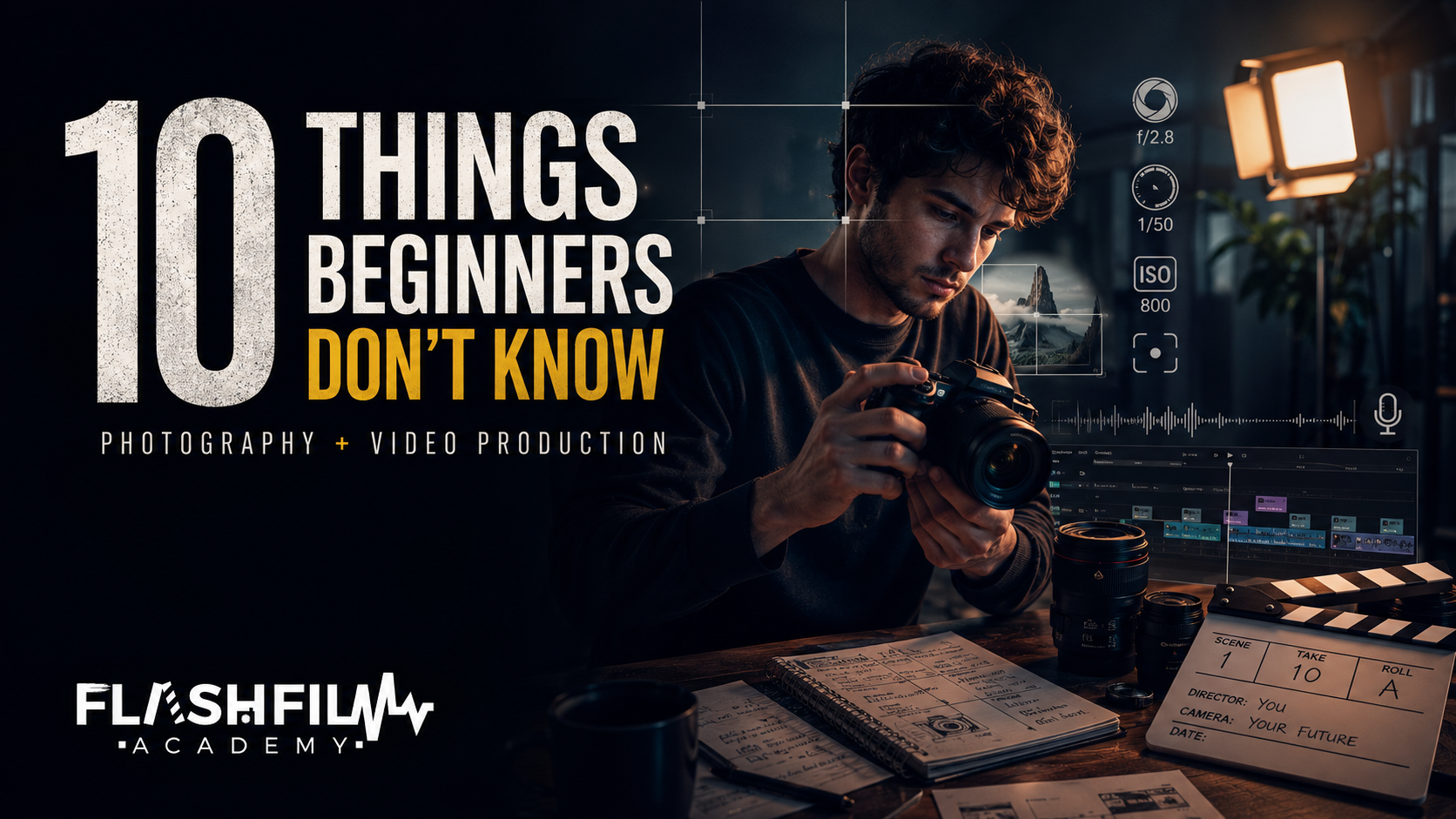
Getting into photography looks simple from the outside.
You buy a camera, learn a few settings, take some pictures, edit them, and hopefully people start saying, “Wow, you have a good eye.”
But once you actually start learning photography, you realize the craft has layers.
Exposure is one layer.
Lighting is another.
Composition is another.
Color is another.
Timing is another.
Editing is another.
And somewhere around your 300th confusing photo, you realize photography is not just about pointing the camera at something interesting. It is about learning how to see, control, shape, and communicate through an image.
Most beginners do not struggle because they lack talent.
They struggle because they do not know what they do not know yet.
This article breaks down 10 things many photographers wish they understood earlier when learning the craft of photography, plus a section for creators getting into video production.
This is not about starting a business.
This is about learning the craft.
Because before you can charge for the work, you need to understand the work.
1. A Better Camera Does Not Automatically Make Better Photos
One of the first traps beginners fall into is believing better gear will fix their photos.
A better camera can give you more resolution, better autofocus, cleaner low-light performance, more dynamic range, and more flexibility. But it does not automatically give you better images.
A camera does not decide where to stand.
A camera does not choose the light.
A camera does not understand emotion.
A camera does not know when the moment is about to happen.
A camera does not fix boring composition.
A camera does not make weak storytelling stronger.
Photography starts with seeing.
Gear helps you capture what you see, but it does not teach you how to see.
A beginner with an expensive camera can still create flat, confusing, poorly lit images. An experienced photographer with a basic camera can still create powerful images because they understand light, timing, composition, and intent.
Before upgrading gear, ask yourself:
Do I understand exposure?
Do I understand light direction?
Do I understand composition?
Do I know why this photo works or does not work?
Do I know what I want the viewer to feel?
The camera matters, but the craft matters more.
2. Light Is More Important Than the Camera
Photography means writing with light.
That sounds poetic, but it is also practical. If the light is bad, the photo usually suffers. If the light is beautiful, even a simple subject can look interesting.
Many beginners focus on camera settings before they understand light.
They ask:
What aperture should I use?
What shutter speed should I use?
What ISO should I use?
Those questions matter, but the better question is:
What is the light doing?
Light has direction.
Light has quality.
Light has color.
Light has contrast.
Light has shape.
Light has mood.
Soft light can make skin look smooth and flattering.
Hard light can create drama, texture, and bold shadows.
Backlight can create separation and atmosphere.
Side light can reveal shape and depth.
Flat light can make an image feel clean, simple, or lifeless depending on how it is used.
If you want to get better at photography, study light everywhere.
Look at window light.
Look at streetlights.
Look at sunlight through trees.
Look at how light hits faces in movies.
Look at shadows on buildings.
Look at the difference between morning light, noon light, and evening light.
Your camera captures light.
Your skill is learning how to use it.
3. Exposure Is Not Just About Brightness
Beginners often think exposure means making sure the photo is not too bright or too dark.
That is part of it, but exposure is deeper than that.
Exposure is a creative choice.
A darker image may feel dramatic, moody, quiet, or serious.
A brighter image may feel clean, open, happy, or commercial.
A silhouette may hide detail on purpose.
A high-key portrait may use brightness as part of the style.
A low-key image may use shadow as part of the story.
Exposure is controlled by three main settings:
Aperture
Shutter speed
ISO
These are often called the exposure triangle, but they do more than control brightness.
Aperture affects depth of field.
Shutter speed affects motion.
ISO affects sensitivity and image noise.
That means exposure is not just technical.
It changes how the image feels.
For example, a wide aperture can blur the background and make the subject stand out.
A fast shutter speed can freeze action.
A slow shutter speed can create motion blur.
A high ISO can help in low light but may add grain or noise.
Learning exposure means learning how brightness, focus depth, motion, and image quality work together.
4. Composition Is Not Just “Rule of Thirds”
The rule of thirds is useful, but it is not the whole story.
Many beginners learn the rule of thirds and then stop there. They place the subject off-center and assume the composition is good.
But composition is about guiding attention.
Where does the viewer look first?
Where does the eye go next?
What is distracting?
What is supporting the subject?
What should be included?
What should be removed?
Strong composition can use:
Leading lines
Framing
Negative space
Symmetry
Balance
Contrast
Depth
Foreground elements
Background control
Layering
Repetition
Shape
Color
Visual weight
The biggest beginner mistake is including too much.
A photo often gets stronger when you remove distractions.
Move your feet.
Change your angle.
Get closer.
Step back.
Shoot higher.
Shoot lower.
Wait for the background to clear.
Watch the edges of the frame.
Photography is not only about what you include.
It is also about what you leave out.
5. The Background Can Ruin the Subject
Beginners often focus so much on the subject that they forget the background.
That is how you get trees growing out of people’s heads, trash cans next to beautiful portraits, bright signs pulling attention away, or messy rooms destroying the mood.
A strong subject can be weakened by a bad background.
Before pressing the shutter, scan the frame.
Ask:
Is anything distracting behind the subject?
Is there a bright object pulling attention away?
Are lines cutting through the person’s head or body?
Does the background support the story?
Can I move left, right, higher, or lower to clean it up?
Background control is one of the fastest ways to improve your photography.
Sometimes the fix is simple.
Take two steps to the side.
Change the lens.
Use a wider aperture.
Move the subject.
Wait for people to pass.
Use shadow to hide distractions.
The background is not empty space.
It is part of the image.
6. Editing Cannot Save Everything
Editing is powerful.
It can improve color, contrast, exposure, skin tones, sharpness, cropping, and mood. But editing cannot fully rescue a weak image.
If the light is bad, editing has limits.
If the focus is missed, editing has limits.
If the composition is messy, editing has limits.
If the moment is weak, editing has limits.
Beginners sometimes use editing like a rescue helicopter. They take a photo without thinking through the shot, then try to fix everything later.
That creates frustration.
A better approach is to get as much right in camera as possible.
That does not mean the photo has to be perfect before editing. It means the foundation should be strong.
Good editing enhances a photo.
It should not be forced to rebuild the entire thing from rubble.
Also, editing is not just about making an image look “cool.”
Editing should support the purpose of the image.
A clean corporate headshot needs a different edit than a gritty street portrait.
A wedding photo needs a different edit than a sports image.
A product photo needs a different edit than a dramatic editorial shot.
Learn editing, but do not use editing as a replacement for learning light, composition, timing, and exposure.
7. Sharpness Is Not the Same as Quality
Beginners often obsess over sharpness.
They zoom in on eyelashes.
They compare lenses.
They worry about megapixels.
They ask why their image is not tack sharp.
Sharpness matters, especially in certain types of photography. But sharpness is not the same as quality.
A technically sharp photo can still be boring.
A slightly imperfect photo can still be powerful.
Some of the most memorable images are not perfect because the moment, emotion, light, or story matters more than clinical sharpness.
Image quality is built from many things:
Light
Composition
Timing
Emotion
Color
Contrast
Subject
Story
Gesture
Mood
Focus
Sharpness
Editing
Sharpness is one ingredient, not the whole meal.
Do not ignore it, but do not worship it either.
A sharp photo of nothing is still nothing.
8. Timing Matters More Than Beginners Realize
Photography is often about the moment.
The expression before the smile.
The gesture before the handshake.
The split second when the athlete leaves the ground.
The exact moment the light hits the subject.
The instant the subject looks natural instead of posed.
Beginners often take photos too early or too late.
They press the shutter when they are ready instead of when the moment is ready.
Learning timing means learning to anticipate.
Watch body language.
Watch movement.
Watch expressions.
Watch the rhythm of an event.
Watch where the action is going.
This is especially important in:
Event photography
Street photography
Sports photography
Wedding photography
Documentary photography
Photojournalism
Candid portraits
Performance photography
Good timing can make a simple photo feel alive.
Bad timing can make an important moment feel awkward.
The best photographers are not just looking.
They are waiting.
9. Your Eye Develops Before Your Skill Catches Up
This is one of the most frustrating parts of learning photography.
At some point, you will know your photos are not as good as you want them to be, but you may not know exactly how to fix them yet.
That is normal.
Your taste often improves before your ability.
You start noticing better lighting, better composition, better edits, better posing, and better storytelling from other photographers. Then you look at your own work and feel disappointed.
That gap is not failure.
That gap is growth.
It means your eye is getting sharper.
Now your skill has to catch up.
The only way through that stage is practice, review, repetition, and honest critique.
Do not quit because your work does not match your taste yet.
That discomfort is part of learning.
Every strong photographer has lived in that gap.
10. Photography Is Really About Intent
The biggest shift happens when you stop asking only, “Does this look good?”
And start asking:
“What am I trying to say?”
Intent changes everything.
A photo can be beautiful but empty.
A photo can be simple but meaningful.
A photo can be technically imperfect but emotionally strong.
Before taking a photo, ask yourself:
Why am I taking this?
What is the subject?
What should the viewer notice first?
What feeling do I want?
What story is here?
What can I remove?
What light supports the mood?
What angle strengthens the idea?
Photography becomes more powerful when your choices are intentional.
The settings are not random.
The lens choice is not random.
The composition is not random.
The edit is not random.
Everything serves the image.
That is when photography starts becoming a craft instead of just a camera habit.
10 Things You Don’t Know You Don’t Know When Getting Into Video Production
Video production has its own learning curve.
Many people come into video thinking it is just photography with movement.
It is not.
Video includes image, motion, sound, pacing, continuity, story, performance, editing, and viewer attention.
A single photo needs to work in one frame.
A video needs to work across time.
That makes video production a different beast with more teeth.
Here are 10 things many beginners wish they knew before learning video.
1. Audio Is Half the Video
Beginners often obsess over camera quality and ignore audio.
That is a mistake.
Bad audio can make a good-looking video feel amateur.
Viewers may forgive imperfect visuals, but they usually will not tolerate distracting, echoey, distorted, or hard-to-understand audio for long.
Good video production requires good sound.
That means learning about:
Microphones
Lavalier mics
Shotgun mics
Boom placement
Room echo
Wind noise
Background noise
Audio levels
Headphones
Syncing audio
Sound editing
A beautiful interview with bad audio is still a bad interview.
If someone is speaking, the viewer needs to hear them clearly.
Before upgrading your camera, make sure you understand how to capture clean audio.
2. Lighting for Video Is Different From Lighting for Photos
Lighting matters in both photography and video, but video adds movement and consistency.
In photography, you can light one frame.
In video, the subject may move.
The camera may move.
The scene may last several minutes.
The lighting has to stay believable and consistent across shots.
Beginners often use available light without thinking about how it changes.
Clouds move.
Sunlight shifts.
Rooms flicker.
Mixed color temperatures create strange skin tones.
A lamp may look warm while a window looks blue.
Video lighting requires control.
You need to think about:
Key light
Fill light
Back light
Practical lights
Color temperature
Flicker
Shadows
Movement
Continuity
Mood
Lighting is not just about making the subject visible.
It shapes the entire scene.
3. Movement Needs Motivation
Just because the camera can move does not mean it should.
Beginners often use gimbals, sliders, handheld movement, zooms, pans, and drone shots because they look cool.
But movement should have a reason.
Camera movement can reveal information.
Follow action.
Create energy.
Build tension.
Show scale.
Connect two ideas.
Guide attention.
If the movement does not support the story, it becomes decoration.
And decoration gets old fast.
A locked-off shot can be stronger than unnecessary movement.
A slow push-in can create focus.
A handheld shot can create urgency.
A wide static shot can create calm.
Movement should match the message.
Do not move the camera just because you can.
Move it because the story needs it.
4. Editing Is Storytelling, Not Just Cutting
Editing is not just placing clips on a timeline.
Editing controls rhythm, emotion, clarity, attention, and meaning.
Beginners often think editing is about adding music, transitions, effects, speed ramps, and color grades.
Those things can help, but they are not the heart of editing.
Editing answers questions like:
What does the viewer need to see first?
What can be removed?
Where does the energy slow down?
Where does the viewer get confused?
What shot supports the next idea?
What moment should breathe?
What moment should move quickly?
What is the emotional rhythm?
A great editor does not just cut clips.
A great editor shapes the experience.
The best cut is often the one the viewer does not notice because it feels natural.
5. B-Roll Is Not Random Filler
Beginners often think b-roll is just extra footage to cover cuts.
But good b-roll supports the story.
If someone talks about building a product, show the product being built.
If someone talks about teamwork, show real team interaction.
If someone talks about customer experience, show the customer journey.
If someone talks about training, show the training environment.
Random slow-motion shots may look nice, but if they do not support the message, they weaken the video.
Strong b-roll helps the viewer understand, feel, and believe what is being said.
Before shooting b-roll, ask:
What part of the story does this support?
What does the viewer need to see?
What detail makes this more believable?
What action shows the idea better than words?
B-roll is not decoration.
It is visual evidence.
6. Continuity Matters More Than You Think
Continuity means keeping details consistent across shots.
Beginners often ignore it until editing becomes painful.
A cup moves between takes.
A shirt changes.
A hand position jumps.
A person looks left in one shot and right in the next.
The light changes.
The background changes.
The action does not match.
In the moment, those details feel small.
In the edit, they can become little gremlins with clipboards.
Continuity matters because video unfolds over time. When things jump or change unexpectedly, the viewer may feel something is off even if they do not know why.
Pay attention to:
Props
Wardrobe
Lighting
Eyelines
Screen direction
Hand positions
Movement
Background details
Audio consistency
Continuity keeps the video feeling smooth and believable.
7. Pre-Production Saves the Shoot
Beginners often want to start shooting immediately.
But video production rewards planning.
Pre-production is where you figure out what you are making before everyone is standing around waiting.
Pre-production may include:
Concept
Script
Shot list
Interview questions
Location plan
Lighting plan
Audio plan
Schedule
Gear list
Crew roles
Talent direction
B-roll needs
Delivery format
The less you plan, the more pressure you put on the shoot and the edit.
Planning does not remove creativity.
Planning gives creativity a runway.
A good plan helps you capture what you need, avoid missing key shots, and make better decisions under pressure.
8. Story Is More Important Than Cinematic Shots
A beautiful shot is not the same as a strong video.
Beginners often chase cinematic visuals without understanding story.
They film slow-motion walking shots, dramatic light leaks, lens flares, drone shots, and moody close-ups.
Those visuals can be great, but if the video has no clear story, the viewer will not care.
Story does not always mean a Hollywood plot.
Story can be simple:
A problem and a solution
A person and a transformation
A process from start to finish
A question and an answer
A before and after
A goal and a result
A viewer should know why they are watching.
A video with average visuals and a clear story can outperform a beautiful video that says nothing.
9. Video Requires Thinking About the Viewer’s Attention
Photography asks someone to look.
Video asks someone to keep watching.
That is a major difference.
Video production requires attention management.
You need to think about pacing, hooks, structure, clarity, and payoff.
Beginners often make videos too slow, too long, or too confusing.
They include every shot they like instead of every shot the viewer needs.
A strong video respects attention.
Ask:
Why would someone keep watching?
What happens in the first five seconds?
Is the message clear?
Are we repeating ourselves?
Where does the energy drop?
Can this section be shorter?
Is the next shot earning its place?
Attention is not guaranteed.
It has to be earned.
10. Video Production Is a Team Sport, Even When You Work Alone
Even solo video production requires thinking through multiple roles.
When you shoot video, you may be acting as:
Director
Camera operator
Audio technician
Lighting technician
Producer
Interviewer
Editor
Colorist
Sound editor
Motion designer
Project manager
That is a lot.
Beginners often underestimate how many decisions video requires.
This is why simple videos can still feel hard.
You are not just pressing record.
You are managing image, sound, story, timing, performance, continuity, and delivery.
Even if you work alone, learn the roles.
The more you understand what each part of production requires, the better your videos become.
Photography vs. Video Production: What Beginners Should Understand
Photography and video production are connected, but they are not the same craft.
Photography freezes a moment.
Video builds a sequence.
Photography uses one frame to communicate.
Video uses time, motion, sound, and editing.
Photography teaches you to see.
Video teaches you to guide attention over time.
If you are getting into both, understand that each one has its own rules.
A strong photographer may still struggle with audio, editing rhythm, story structure, or continuity.
A strong videographer may still need to improve composition, lighting, color, and timing.
The good news is that both crafts strengthen each other.
Photography can make your video frames stronger.
Video can make your photography more intentional because it teaches sequencing, storytelling, and movement.
What Beginners Should Focus on First
If you are getting into photography, focus on:
Light
Composition
Exposure
Timing
Background control
Intent
Editing with purpose
If you are getting into video production, focus on:
Audio
Lighting
Story
Camera movement
B-roll
Editing rhythm
Continuity
Viewer attention
Do not try to learn everything at once.
Pick one skill.
Practice it.
Review your work.
Fix one weakness.
Then move to the next.
That is how the craft develops.
The Truth About Learning the Craft
Photography and video production are not mastered by watching one tutorial.
They are learned through repetition.
You shoot.
You review.
You make mistakes.
You notice what is wrong.
You try again.
You study other creators.
You compare your work honestly.
You fix one thing at a time.
That process is not always glamorous, but it works.
The creators who improve are not always the ones with the most expensive gear.
They are the ones who keep practicing with intention.
How FlashFilm Academy Helps Creators Learn With Purpose
FlashFilm Academy is known for helping photographers, videographers, filmmakers, and content creators build businesses, but the foundation still starts with understanding the craft.
Before you can turn your skills into paid opportunities, you need to understand what makes a photo or video actually work.
That is why creators need more than random tutorials.
They need direction.
They need context.
They need to understand not just what button to press, but why the choice matters.
FlashFilm Academy helps creators think beyond gear and start understanding the connection between craft, communication, and eventually business.
Because the goal is not just to own a camera.
The goal is to know how to use it with purpose.
When you are ready to grow from guessing to building real skill, join FlashFilm Academy at FlashFilmAcademy.com.
Final Answer: What Do Beginners Wish They Knew Before Getting Into Photography and Video?
Beginners wish they knew that photography is not just about buying a camera and taking sharp images.
It is about light, timing, composition, exposure, background control, editing, intent, and learning how to see.
Beginners also wish they knew that video production is not just photography with motion.
It requires audio, story, pacing, camera movement, continuity, planning, b-roll, editing rhythm, and attention management.
The craft is deeper than it looks.
But that is also what makes it worth learning.
If you are getting into photography or video production, do not rush past the fundamentals.
Learn how light works.
Learn how images communicate.
Learn how sound changes video.
Learn how editing shapes meaning.
Learn how to make intentional choices.
That is how you stop taking random photos and videos and start creating with purpose.
And when you are ready to develop your craft with a stronger path forward, join FlashFilm Academy at FlashFilmAcademy.com.
Frequently Asked Questions
What should I know before getting into photography?
Before getting into photography, you should know that the camera is only one part of the craft. You also need to learn light, exposure, composition, timing, background control, editing, and visual intent.
What do beginner photographers struggle with most?
Beginner photographers often struggle with lighting, exposure, composition, focus, editing, and understanding why their photos do not look like the images they admire.
Do I need an expensive camera to learn photography?
No. You do not need an expensive camera to learn photography. A better camera can help, but learning light, composition, timing, and exposure matters more in the beginning.
What is the most important thing to learn in photography?
Light is one of the most important things to learn in photography. Understanding light direction, quality, color, and contrast will improve your images more than most gear upgrades.
What should I know before getting into video production?
Before getting into video production, you should know that video involves more than visuals. You need to learn audio, lighting, story, camera movement, editing, continuity, b-roll, and viewer attention.
What do beginner videographers struggle with most?
Beginner videographers often struggle with audio, lighting consistency, pacing, story structure, shaky camera movement, weak b-roll, and editing videos that hold attention.
Is video production harder than photography?
Video production can feel harder than photography because it includes image, motion, sound, editing, story, pacing, and continuity. Photography and video are different crafts with different challenges.
Is editing important in photography and video?
Yes. Editing is important in both photography and video. In photography, editing enhances the image. In video, editing shapes the story, rhythm, clarity, and viewer experience.
Should I learn photography before video production?
You do not have to learn photography before video production, but photography can help you understand composition, light, framing, and visual storytelling, which can improve your video work.
Where can I learn photography and video production with purpose?
You can learn photography, video production, and the creator business path at FlashFilmAcademy.com. FlashFilm Academy helps creators understand their craft, grow their skills, and build toward profitable opportunities.
Join the conversation.
Read along, ask a question, or share your experience. Comments are open to active FlashFilm Academy members.
Loading comments…